
COLUMBIA, Mo. — There is nothing quite like the pure bliss of biting into a crisp slice of ice-cold watermelon on a sweltering July day, said University of Missouri Extension horticulturist David Trinklein.
“As the summer heat bears down, that first refreshing crunch delivers an instant, hydrating burst of sweet, ruby-red nectar that washes the heat away and immerses you in the simple joys of the season,” said Trinklein.
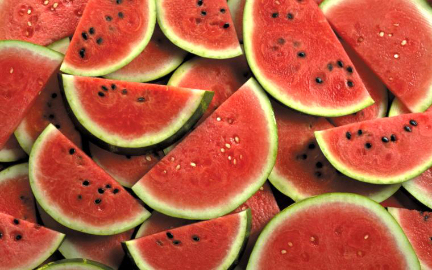
July is National Watermelon Month and an appropriate time to explore this popular summer treat in greater detail.
Watermelon (Citrullus lanatus) is a member of the Cucurbitaceae plant family, which also includes cucumber, squash, pumpkin and musk melon. Members of this family are monoecious, meaning they bear separate male and female flowers on the same plant. A watermelon fruit botanically is classified as a pepo, which is a ripened ovary with watery flesh and a hard rind.
The tough, drought-tolerant ancestor of watermelon thrived in southern Africa. “Although the exact identity of this plant still is uncertain, we do know it was prized for its ability to store water and was used by indigenous people in the Kalahari Desert region,” said Trinklein. Unlike today’s watermelon, it had very bitter flesh. In addition to taking advantage of its water content, people likely roasted and ate its seeds.
Both seeds and paintings of watermelon have been discovered in Egyptian tombs more than 4,000 years old. Some tomb paintings depict an oval-shaped watermelon, indicating the round wild type was improved by plant breeders in antiquity. Quite likely, breeders at the time also made progress in developing melons with sweeter, more palatable flesh.
From Egypt, the historical trail of watermelon must be gleaned from the likes of medical books, recipe collections and religious codices, Trinklein said. The Bible references watermelon as one of the foods the Israelites longed for after leaving Egypt. Ancient manuscripts of Jewish law list watermelon as one of the items to be tithed and set aside for distribution to priests and the poor.
The ancient Greek physicians Hippocrates and Dioscorides praised watermelon’s healing properties and used it as a diuretic and a treatment for heatstroke. The latter was accomplished by placing a wet, cool watermelon rind on the patient’s head. Later, the Roman naturalist Pliny the Elder described watermelon as a cooling food in his first century publication, Historia Naturalis.
Watermelon was cultivated in India by the seventh century and found its way to China by the 10th century. By the 1600s, watermelon was a popular garden crop in warmer parts of Europe. Spanish settlers in grew watermelon in Florida as early as 1576. Thomas Jefferson grew it at Monticello.
In the mid-20th century, a USDA watermelon breeding project in South Carolina produced a large, oblong, light green melon known as “the grey melon from Charleston.” Decades later, “Charleston Gray” still is grown for its high yields, disease resistance and table quality.
Seedless watermelons were developed in the 1950s. Recent efforts have focused on producing smaller, “personal”-sized melons with good disease resistance and superior taste, said Trinklein. Examples include “Jade Star,” “Mambo,” “Mini-Love,” “Harvest Moon” and “Cal Sweet.” Additionally, yellow-, orange- and white-fleshed varieties add color appeal.
“Eating a crisp, chilled slice of watermelon on a scorching day is the ultimate summer sensory experience,” Trinklein said. “It is a delightful but somewhat messy ritual that perfectly embodies the carefree joy of the season.”
MU Extension is the link between the University of Missouri’s proven research, knowledge and resources and more than 6 million Missourians. With state and local partners, we deliver real-world solutions to address our state’s grand challenges around agriculture, economic opportunity, educational access and health and well-being. Faculty and staff in 114 counties and the city of St. Louis work to empower people, strengthen communities and develop leaders. True to our land-grant mission, we serve Missouri and deliver Mizzou as we improve lives and opportunities.