
The Ste. Genevieve County woodsman was a pioneer in sustainable forestry.
By Brian Schweiss, University of Missouri Extension sustainable forestry specialist. For assistance with this article, the author expresses his gratitude to Mark Basler, grandson of Pine Tree Jim, and Linn Tucker, private lands crew leader with the Missouri Department of Conservation.
WEINGARTEN, Mo. – Legend has it that Pine Tree Jim was born in a forest clearing in 1882, a beginning he considered his greatest heritage. It is fitting, then, that he spent his life as a woodsman.
Jim Horton—known throughout Ste. Genevieve County as Pine Tree Jim—lived and farmed the family land near Weingarten and the Miller Switch Store.
At a time when most landowners were clearing forests for agriculture, Horton took a different path. He saw value in managing his pine and oak woods rather than removing them.
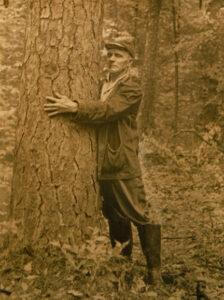
Woodsman Jim Horton, known as Pine Tree Jim, stands next to a Ste. Genevieve pine. It is estimated that the photo was taken in the 1940s. Horton is considered a pioneer in the area of sustainable forestry. Photo courtesy of Mark Basler, grandson of Jim Horton.
Horton watched his trees closely, harvesting only when they matured or showed signs of decline. By removing dying or poor-quality trees, he created space and sunlight for healthy pines and oaks to grow. His thoughtful approach drew the attention of foresters, including David Bauch of the U.S. Forest Service, who wrote in 1946 that Horton’s “wise use” had not only maintained the original value and volume of timber but increased it.
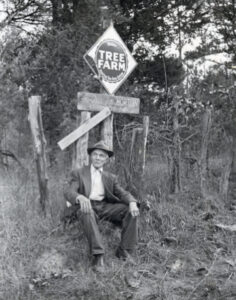 Horton saw value in managing his pine and oak woods rather than removing them. Here he is shown next to the farm’s Tree Farm sign in the 1960s. The American Tree Farm System was created by the timber industry in 1941 to promote sustainable forestry on private land. Photo courtesy of Mark Basler, grandson of Jim Horton.
Horton harvested wood annually to meet local and regional demand for pine lumber, posts and farm equipment. It is said he tripled the volume of timber on his land during his lifetime. As he explained, “My system consists of cutting trees that only need to be cut—not trees I might like to cut—and no more than grows each year.” His philosophy reflected an early understanding of sustainable forestry long before the term became common.
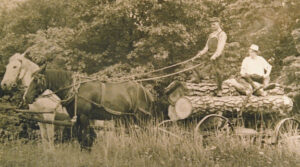 Pine Tree Jim Horton harvested trees on his property only when they matured or showed signs of decline. By removing dying or poor-quality trees, he created space and sunlight for healthy pines and oaks to grow, leaving behind healthy woodlands for generations to come. Photo courtesy of Mark Basler, grandson of Jim Horton.
Recognizing the importance of replanting, Horton established pine stands on close spacing. Young trees removed during thinning were sold as Christmas trees, hauled to Ste. Genevieve, and eventually shipped to St. Louis by steamboat. Between 1942 and 1946, he purchased thousands of seedlings—shortleaf, jack and Virginia pine—from the George O. White State Forest Nursery.
According to a 1948 article in the Weekly Kansas City Star, he planted 2,600 trees during this period and planned to plant more. “If I knew I had only a year to live I would put in the time planting trees, knowing somebody, sometime, would benefit,” he told the newspaper. His grandson, Mark Basler, recalls helping with planting projects until around 1965.
During the late 1800s and early 1900s, pine across the Missouri Ozarks was heavily harvested by large timber companies. By 1910, many had closed or downsized due to depleted forests. Yet Pine Tree Jim, with his selective-harvest approach, continued producing timber well into the 1950s and beyond. The Horton family even conducted a harvest in 2009 with assistance from the Missouri Department of Conservation.
The legacy of stewardship continued through the family. Horton’s land eventually passed to his brother McKinnley “Mack” Horton, then to Mack’s son, William, and William’s wife, Antje. In 2010, their 640 acres were donated to the Missouri Department of Conservation to become Horton Farm Conservation Area.
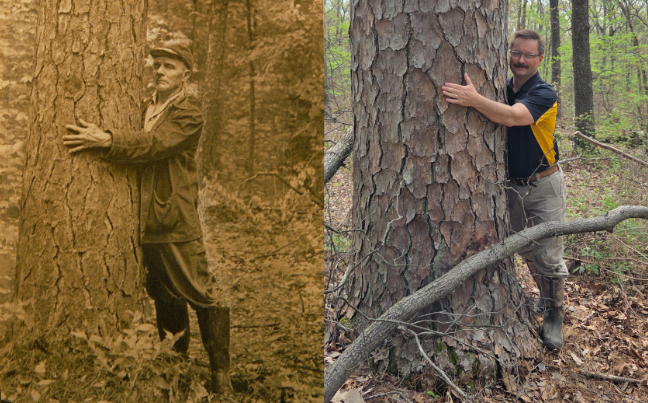 MU Extension sustainable forestry specialist Brian Schweiss (at right) stands next to the same tree that Horton stood next to 80 years earlier.
Today, pines planted by Pine Tree Jim stand 80 years old and 80 feet tall, surrounded by native oaks and hickories. His legacy endures in a thriving forest managed for all to enjoy.