Summary
- Measles cases are surging in the Midwest.
- Individual measles cases have been diagnosed in Missouri in 2026.
- Outbreaks of measles are occurring in adjacent states.
- Health care providers are encouraged to review this alert. For any suspected cases or questions, CALL YOUR LOCAL PUBLIC HEALTH AGENCY or the MISSOURI DEPARTMENT OF HEALTH & SENIOR SERVICES (573-751-6113 during regular business hours or the 24/7 emergency line at 800-392-0272) for detailed help and testing assistance. We are here to help you.
- Ensure all patients without other evidence of immunity, including those planning out of state travel, especially to areas with active outbreaks, are up to date with the measles vaccination (MMR vaccination). Consider a special situation vaccination schedule for infants 6-11 months.
Background
National
As of Aug. 30, 2026, the U.S. Centers for Disease Control and Prevention (CDC) reports 2,903 confirmed measles cases in the U.S. among residents since the beginning of the year. These cases are reported from 47 states, including Missouri. The total number of measles cases nationally has already surpassed the total number for the entire year of 2025. There are 37 new measles outbreaks in 2026, and 94% of confirmed cases are currently outbreak-associated. One third of all measles cases are adults and 94% of confirmed cases are unvaccinated or have unknown vaccination status. Seven percent of all confirmed cases needed hospitalization. The recent surge in measles has been observed in the neighboring states of Kentucky and Iowa, as well as numerous other states throughout the Midwest and nation.
Missouri
Measles cases are happening in health districts directly bordering Missouri with economic and social ties to our state. Missouri’s measles vaccination rate for beginning school age children is 89.5%, well below the 95% needed for preventing disease outbreaks in the community and protecting vulnerable populations who cannot receive vaccines. Even though Missouri is not currently experiencing a measles outbreak and only 5 cases were reported in 2026 as of August 31, the Missouri Department of Health and Senior Services (MDHSS) is urging health care providers to be on alert for possible measles cases presenting to health care facilities anywhere in the state and to review existing measles response plans now.
Measles
Measles is a highly contagious viral illness transmitted by direct contact with infectious droplets or by airborne spread when an infected person breathes, coughs, or sneezes. Measles virus can remain infectious in the air and on surfaces for up to 2 hours after an infected person leaves an area.
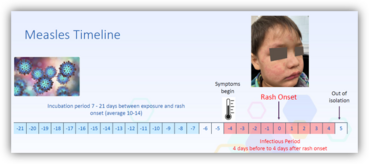
The incubation period for measles, from exposure to fever, is usually about 7–10 days, and from exposure to rash onset is usually about 10–14 days (with a range of 7 to 21 days). Infected people are contagious from 4 days before the rash starts through 4 days afterward.
Measles symptoms start after 7 to 14 days since the contact with the virus, typically with the prodrome:
High fever and 3 Cs:
- Cough
- Coryza (runny nose)
- Conjunctivitis
2–3 days after symptoms begin:
Tiny white spots (Koplik spots) may appear inside the mouth, but this symptom is not universal
3–5 days after symptoms begin:
The measles rash appears and usually begins as flat red spots (macules) that appear on the face at the hairline. They then spread downward to the neck, trunk, arms, legs, and feet.
- Small, raised skin bumps (papules) may also appear on top of the flat red spots.
- The spots may become joined together as they spread from the head to the rest of the body.
- If the rash includes tiny fluid-filled blisters (vesicles), consider an alternative cause of the rash, such as varicella or other.
When the rash appears, a person’s fever may spike to more than 104° Fahrenheit.
Measles Complications
People that are more likely to develop measles complications include:
- Children younger than 5 years of age
- Adults older than 20 years of age
- Pregnant women
- People with weakened immune systems, such as from leukemia or HIV infection
Common complications from measles are ear infections (about 1 out of every 10 children with measles) and diarrhea (less than 1 out of 10 people with measles).
Some people may experience severe complications and need to be hospitalized:
- About 1 out of every 20 children with measles gets pneumonia, the most common cause of death from measles in young children.
- About 1 child out of every 1,000 who get measles will develop encephalitis (inflammation and swelling of the brain), which can leave the child deaf or with intellectual disability.
- Nearly 1 to 3 of every 1,000 children who become infected with measles will die from respiratory and neurologic complications.
- Measles in pregnancy may cause premature birth and/or having a low-birth-weight baby. Congenital measles infection may also occur in a baby.
Long-term complications include:
- Immune amnesia with increased susceptibility to other infections after the recovery from measles lasting months or even up to a few years.
- Subacute sclerosing panencephalitis (SSPE) is a very rare but fatal disease of the central nervous system developing from a measles virus infection acquired earlier in life. SSPE generally appears 7 to 10 years after a person has measles, even though the person seems to have fully recovered from the illness.
- Measles inclusion body encephalitis (MIBE) is a severe, often fatal brain infection predominantly in immunocompromised people who cannot clear the measles virus. Symptoms start months after the initial infection and include refractory seizures and confusion, quickly leading to coma and death.
Measles is uncommon among people with age-appropriate vaccination. One dose provides 93% and two doses provide 97% protection from measles infection. Measles can rarely occur among vaccinated people after intense measles exposure, such as a daycare or household exposure. Measles presentation in such cases often is not classical and fever may not always be present. Measles transmissions from vaccinated cases is relatively uncommon.
Other infections and syndromes that resemble measles should be included in the differential diagnosis. The most common include:
- Parvovirus B-19 (“Fifth Disease”) with classic “slapped cheek” rash. It is more common in school-aged children than infants.
- Human Herpesvirus 6 (HHV-6, “Sixth Disease”, “Roseola”) which is a common cause of febrile rash in infants. The rash typically starts on trunk (measles rash starts on face/hairline). Fever often resolves before the start of rash (measles fever peaks around time of rash onset).
- Enteroviruses, especially those causing Hand/Foot/Mouth disease. This rash can involve hands/feet which are generally spared in measles. The rash can also be urticarial (itchy raised “hives”), which is not typical for measles.
- Up to 5% of MMR recipients will get a short-lived, mild febrile rash, especially with the first dose of MMR. People who experience this vaccine reaction are not contagious to others around them. If a person has received MMR within 21 days before rash onset, but also has epidemiologic risk for measles, then specialized testing may be required and should be discussed with the local public health agency or the Missouri DHSS.
In addition to a clinical presentation suspicious for measles, epidemiological risk factors should be strongly considered prior to initiating measles testing in order to maximize test accuracy.
Epidemiologic risks for measles in the 21 days before the rash onset include:
- Travel out of state
- Domestic travel to an area with known measles transmission
- Known exposure to measles
Once measles is suspected, IMMEDIATELY CALL YOUR LOCAL PUBLIC HEALTH AGENCY or the MISSOURI DEPARTMENT OF HEALTH & SENIOR SERVICES (573-751-6113 during regular business hours or the 24/7 emergency line at 800-392-0272) to report the suspected case or to request measles testing at the Missouri State Public Health Laboratory (MSPHL). MDHSS staff are also available to discuss the following testing options for measles.
Testing Recommendations
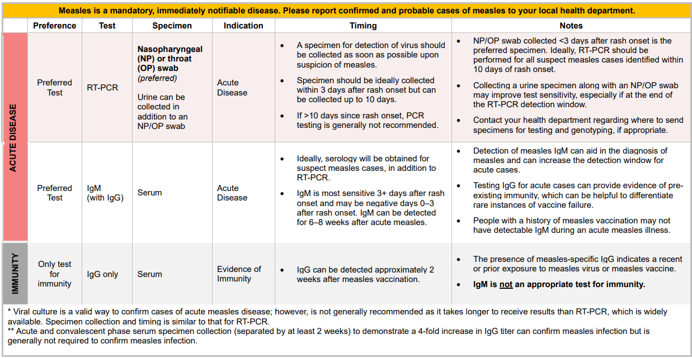
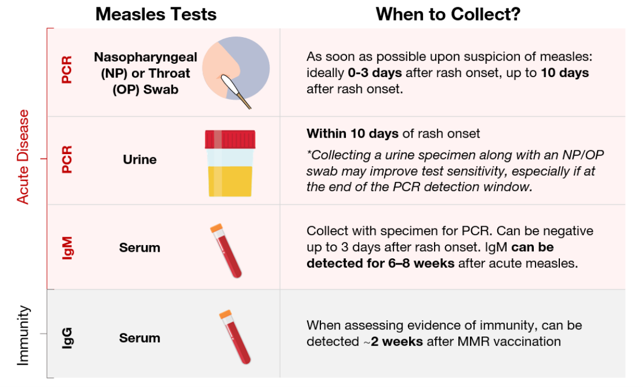
- RT-PCR (reverse transcription polymerase chain reaction) can be performed on respiratory (nasopharyngeal or throat) swabs and on urine. RT-PCR is most sensitive within 3 days of rash onset but can be positive up to 10 days after rash onset. Ideally, specimens should be collected at the first patient contact once measles is suspected and should be paired with serology testing (blood testing for measles IgM) for evaluation of all suspect measles cases. RT-PCR is available through commercial laboratories and through the Missouri State Public Health Lab.
- Detection of the measles IgM antibody in blood can confirm measles. Measles IgM is most sensitive 3 or more days after rash onset, so a negative measles IgM within 3 days of rash onset should be interpreted with caution. Be aware that false-positive measles IgM results can occur due to cross-reactivity with other causes of febrile rashes, such as parvovirus. It is best when RT-PCR and serology measles IgM are performed together for all suspect measles cases. Note that measles IgM is not an appropriate test to evaluate measles immunity.
- The presence of measles IgG antibody in blood indicates a recent or prior exposure to measles virus or measles vaccine and is appropriate to test for evidence of immunity.