
CARBONDALE, Ill. — A doctor scribbles an order for antibiotics on a prescription slip and reminds the patient to take the full dosage, even if they start to feel better before the medication is gone. Sound familiar? It probably does for anyone who has been diagnosed with strep throat, an ear or tooth infection, or even a sinus infection from those pesky allergies. While the doctor’s order seems simple, it’s an important step to follow in the fight against bacteria becoming resistant to antibiotics.
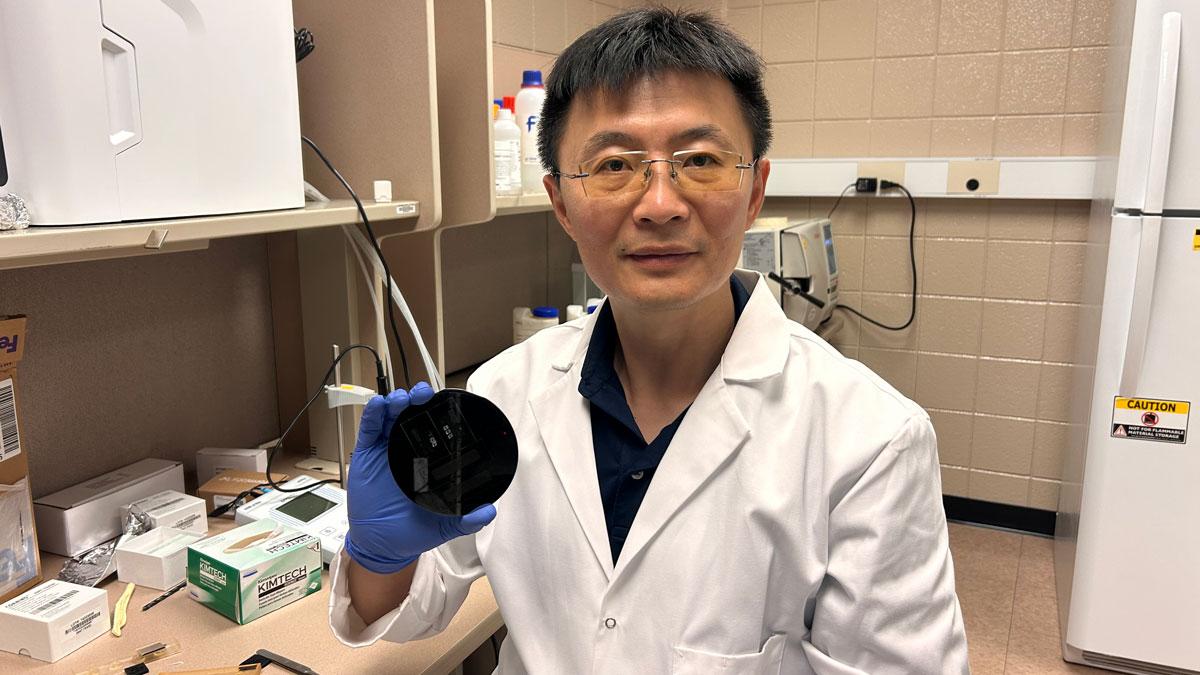
Hui Li, assistant professor in SIU’s School of Electrical, Computer and Biomedical Engineering, holds up a microfluid chip similar to the one used in his research to speed up and improve the accuracy of single-cell bacteria detection using artificial intelligence. (Photo by Brooke Keltner).
Researchers at Southern Illinois University Carbondale are addressing the problem with artificial intelligence that is speeding up and improving single-cell bacteria detection.
Hui Li, assistant professor in the School of Electrical, Computer and Biomedical Engineering, and Spyros Tragoudas, professor and director of the School, first teamed up on the project four years ago. They believe if this technology can be incorporated into hospitals and healthcare settings, it could prove beneficial for doctors and nurses in identifying bacteria, especially those with a resistance to antibiotics.
“I think the main value of this single-cell bacteria detection is that it can really speed up the traditional diagnosis,” Li said. “Then, with AI analyzing the data, the process can be sped up from up to five days to a few hours. This is critical time that can be used to treat the patient and possibly save their life.”
A worldwide health challenge
Less than 100 years ago, the discovery of penicillin became a healthcare breakthrough, and one of the greatest advancements in modern medicine. It became the first antibiotic to treat infections that previously could have been fatal for the patient without the medicine. Now, some bacteria have become resistant to penicillin and other antibiotics, leading to an increased risk during medical procedures like surgeries, more patients being admitted to the hospital, a higher need for intensive care and a reliance on second-line antibiotics.
The Centers for Disease Control and Prevention is concerned about new forms of antimicrobial resistance (AMR) and rising infections. In the United States, more than 2.8 million AMR infections take place each year, leading to more than 35,000 deaths and $4.6 billion in healthcare costs.
This crisis is even more severe globally.
Antimicrobial resistance is a major threat, according to the World Health Organization. The agency’s latest numbers show that AMR is estimated to be associated with more than 4.7 million deaths worldwide — and the total cost to treat resistant bacterial infections is predicted to reach $412 billion annually by the year 2035. The cause of this resistance stems from many factors, including:
- Misuse or overuse of antibiotics
- Limited access to vaccines
- Poor access to clean water, sanitation and hygiene
- Inadequate infection prevention in homes, healthcare facilities and farms
- Lack of awareness and enforcement of relevant legislation
Li and Tragoudas emphasize that antibiotic misuse can result from the lack of quick and precise diagnostic results. They hope their technology can be used in hospitals and other healthcare settings to reduce the occurrence of the issue.
Looking under the microscope
During the experiment, Li put microscopic fluid samples containing E. coli bacteria on a chip – one without antibiotics and the others with varying concentrations of antibiotics. The chips then went under a microscope where real-time imaging captures how the single-cell bacteria change. While this type of experiment has been happening for years, the analysis is typically done manually which slows down the process and can increase the chance for errors. What’s new is the addition of AI for analysis – an idea that Tragoudas came up with.
“The AI will tell you what’s going on with the bacteria like division or growth,” Li said. “I think the combination of single-cell detection with AI for the downstream analysis is a very actionable combination.”
Preliminary results show that within two hours the AI model identified 96% of individual E. Coli cells and showed no false-positive predictions on images without bacteria.
Another benefit of the AI is that it can detect the presence of single-cell bacteria in blood cells. This means it can cut through “complex background noise,” so the technology could have future uses, Li said.
Need for student researchers
Li and Tragoudas need undergraduate and graduate students interested in helping to continue this research. They believe students with a background in engineering, microbiology, artificial technology, or healthcare could benefit from this opportunity.
“Students would gain hands-on experience that would prepare them for their professional careers in the future, especially those who will work in labs or hospital settings” Li said.
Those interested in the lab can reach out to Li at hui.li@siu.edu