
ST. JOSEPH, Mo. – Few houseplants are as charming and whimsical as the shamrock plant, says University of Missouri Extension field horticulturist Gwen Funk. These intriguing houseplants capture attention year-round, not just on St. Patrick’s Day.
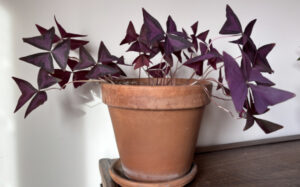
Oxalis triangularis, the purple-leaf shamrock, will have pale purple, bell-shaped flowers. Photo by Gwen Funk, MU Extension horticulturist.
Shamrock plants’ clover-like leaves exhibit a fascinating daily rhythm. They fold in at night as if “sleeping,” then open wide with the morning light. This movement, called nyctinasty, happens when specialized cells at the base of each leaf respond to light cues, swelling or shrinking to raise or lower the leaf.
Although often sold in late winter and early spring for St. Patrick’s Day, shamrock plants can thrive indoors year-round with proper care. They belong to the Oxalidaceae, or wood sorrel, family.
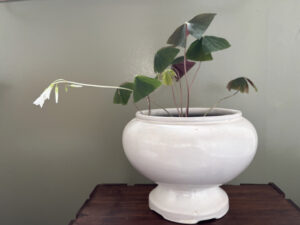
Oxalis regnellii, sometimes called the lucky shamrock, is one that is commonly sold around St. Patrick’s Day. Photo by Gwen Funk, MU Extension horticulturist.
The plants commonly marketed as “shamrocks” are not true Irish shamrocks but several species of Oxalis, including Oxalis regnellii (lucky shamrock), Oxalis triangularis (purple-leaf shamrock) and Oxalis deppei (good-luck plant, often sold as a four-leaf clover).
The true Irish shamrock is Trifolium dubium, a yellow-flowered clover.
Growing recommendations
Light: Shamrock plants prefer bright, indirect light. An east- or west-facing window works well. Too little light results in sparse growth and fewer blooms, while harsh, direct sunlight may scorch the leaves.
Water: Keep potting medium evenly moist during active growth, allowing the surface to dry slightly between waterings. Avoid waterlogging, as shamrocks are sensitive to excess moisture and may develop root or tuber rot. Good drainage is essential.
Temperature and humidity: Average indoor temperatures of 60–75 F suit these plants well. They prefer cooler nights and do not tolerate prolonged heat. Normal household humidity is usually adequate.
Fertilization: Feed with a balanced, water-soluble fertilizer at half strength every three to four weeks during active growth. Avoid fertilizing when the plant is dormant.
Understanding dormancy
Shamrock plants naturally enter a resting period, typically after flowering or during times of stress such as high temperatures or reduced light. Leaves may yellow, droop or die back completely.
“Don’t throw out the plant, as this is a natural part of the shamrock’s growing cycle,” says Funk.
She offers tips to manage dormancy:
- Reduce watering to keep the soil barely moist.
- Move the pot to a cool, dry location with indirect light.
- Do not fertilize during this period.
After several weeks to a few months, new growth will emerge from the underground tubers. Resume normal watering and return the plant to bright, indirect light once growth resumes. This cycle is normal and should be expected annually.
Common problems and solutions
Yellowing or drooping leaves: Usually caused by overwatering or poor drainage. Ensure the container allows excess water to escape.
Sparse growth or lack of blooms: Often due to insufficient light. Move the plant to a brighter location, but avoid harsh midday sun.
Sudden leaf drop: Most likely dormancy, not disease. Adjust care based on seasonal needs.
Leggy growth: Indicates low light. Increase light exposure for more compact growth.
Pests: Generally pest-resistant, though aphids and spider mites may appear. Treat promptly with insecticidal soap or rinse foliage thoroughly.
“With proper light, watering and an understanding of its natural dormancy cycle, the shamrock plant can be a reliable and long-lasting houseplant,” Funk says. “Just remember that dormancy is a normal part of the plant’s life cycle and adjust care practices accordingly. By responding to the plant’s needs throughout the year, homeowners can enjoy its delicate form and delightful blooms for many years.”