
Source: David Trinklein
COLUMBIA, Mo. – Rhubarb shows up tart, bold, and unapologetically itself. Someone once said, “If confidence were edible, it would taste like rhubarb.” Others have likened it to celery with an attitude problem.
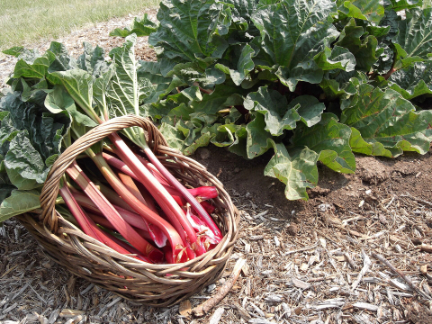
Photo by RhubarbFarmer. Shared under a Creative Commons license (CC BY-SA 3.0), via Wikimedia Commons.
Rhubarb is also one of the most prized garden plants, said University of Missouri Extension horticulturist David Trinklein. Rhubarb and asparagus are the only perennial vegetables grown in the Midwest.
Rhubarb (Rheum rhabarbarum) is a member of the Polygonaceae (or buckwheat) plant family. Its leafstalks are extremely tart with a texture like celery.
Only the leafstalk of this cool-season plant is edible. Rhubarb’s large, floppy leaves contain a substance called oxalic acid, which can cause kidney stones and aggravate kidney issues.
The Chinese used rhubarb as a medicinal herb more than 5,000 years ago. When it was introduced into Europe, people mistakenly ate its leaves. The ensuing cramps, nausea and sometimes death dampened interest in the plant for about 200 years. It was not until the 18th century that it became a valuable food plant in Europe.
Introduced to the United States by Benjamin Franklin, rhubarb technically is a vegetable, even though it is commonly prepared like fruit in sweetened desserts.
Rhubarb is nicknamed the “pie plant.” Its popularity grew to a peak just before World War II. However, possibly due to sugar rationing, its culinary use dropped dramatically during and after the war.
Rhubarb is a nutrient-dense, low-calorie vegetable that supports heart, bone and digestive health. It is valued for its significant fiber, vitamin K and antioxidant content.
Researchers continue to study the potential medicinal benefits of rhubarb root extract. In traditional Chinese medicine, it is used for treating gastrointestinal issues, alleviating menopause symptoms, reducing inflammation, and offering antioxidant, anti-cancer and liver-protecting benefits.
Rhubarb prefers rich, well-drained soil. Since much of Missouri is not blessed with this type of soil, gardeners may want to incorporate well-decomposed organic matter (e.g. compost) into the soil for best results, said Trinklein.
Planting location matters since rhubarb needs at least six hours of sunlight daily. Because it is a cool-season plant, it favors afternoon shade in Missouri. It does not grow well in most of southern Missouri because of higher summer temperatures.
Gardeners need to exercise patience when planting rhubarb. It takes time to establish itself.
Do not harvest rhubarb for the first year after planting, and limit harvest during the second and third years. By the fourth year, harvest fully beginning in late March or early April, but never remove more than two-thirds of existing stalks at one harvest.
Harvest lasts about two months, according to Trinklein. Don’t harvest rhubarb with a knife, as this encourages crown rot. Instead, gather rhubarb by twisting off the leaf stalk at the soil line and cutting off the leaf.
Once harvested, rhubarb can be stored in a refrigerator for 5-7 days, or it can be frozen.
Trinklein offers these tips:
- Plant dormant divisions about an inch below the soil line and about 2-3 feet apart in rows separated by the same distance.
- Apply ½ cup of all-purpose garden fertilizer (e.g. 10-10-10) per plant when spring growth begins.
- Mulch with manure or compost to improve soil structure and drainage.
- Remove flower stalks if they appear. This forces the plant to put its energy into the leaves and roots instead of flowers and seeds.
MU Extension is the link between the University of Missouri’s proven research, knowledge and resources and more than 6 million Missourians. With state and local partners, we deliver real-world solutions to address our state’s grand challenges around agriculture, economic opportunity, educational access and health and well-being. Faculty and staff in 114 counties and the city of St. Louis work to empower people, strengthen communities and develop leaders. True to our land-grant mission, we serve Missouri and deliver Mizzou as we improve lives and opportunities.
MU Extension news: extension.missouri.edu/news