
COLUMBIA, Mo.—Few garden perennials deserve the title “heirloom” more so than Madonna lily: some historians believe it is the first to have been cultivated by humans for ornamental purposes.
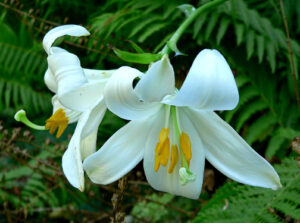 Madonna lily. Photo by Stan Shebs
August is an ideal month for planting this iconic beauty and a good time to explore it in greater detail, said University of Missouri Extension horticulturist David Trinklein.
Madonna lily (Lilium candidum) should not be confused with Easter lily (Lilium longiflorum), whose flowers are somewhat similar in appearance. Madonna lily, a member of the Liliaceae plant family, is thought to be native to the Balkans and Middle East.
Its flowers are depicted on paintings made by the Minoans, a Bronze Age civilization that inhabited Crete and other Aegean islands. It can be found naturalized over much of southern Europe, Ukraine, North Africa, the Canary Islands and even into the New World.
Egyptians crushed its bulbs and used the ointment to treat inflammation, burns and tumors. Later, Greek physician and herbalist Dioscurides reportedly used it to treat diseases of women. Additionally, Romans are said to have used the extract of steeped Madonna lily bulbs to care for sore feet.
The Roman Catholic church has long considered the lily as a symbol of purity. Medieval artworks often depict the Virgin Mary holding, or near, flowers of what, apparently, is Lilium candidum. Clovis I, king of the Franks, upon his conversion to Christianity, is said to have been given a lily from heaven by the Virgin Mary.
Plant Madonna lily in August or early September in a location that receives six or more hours of direct sun daily. In contrast with other lilies that develop “stem roots” and are planted 4-6 inches deep, Madonna lily should have no more than 1 inch of soil covering its bulb.
Water well after planting to encourage root development and rosette formation.
Madonna lily prefers nearly neutral to slightly alkaline soil. In most Missouri soils, ground limestone should be added at planting time.
Unlike most garden lilies, Madonna lily produces a rosette of leaves in the fall that remains throughout the winter. Late in the following spring, a single flower stalk (spike) 24 to 60 inches hight emerges from this rosette. Spikes may hold from three to 12 elegant, pure-white flowers with exquisite fragrance.
Although strikingly beautiful and steeped with history, Madonna lily does have its challenges. It is susceptible to several diseases, including lily mosaic virus and cucumber mosaic virus. Symptoms are not always clearly visible, but most appear as chlorotic mottling of the leaves along with weak growth and eventual death of the plant. Control of these diseases is difficult, since they are spread by insects such as leafhoppers, which feed on the leaves of plants.
Madonna lily also is quite susceptible to botrytis, a fungal disease that favors moderate temperatures with high relative humidity. There are several fungicides available that are labeled for botrytis control on ornamentals. Any product with chlorothalonil as its active ingredient should be effective. Additionally, applying sulfur dust on bulbs before planting may help to prevent infection from any surface wounds that might have occurred during handling.
Lilies of all types, and especially Madonna, are susceptible to root rots, so excellent soil drainage is necessary. Incorporate about 4 inches of aged manure or compost for several weeks before planting to help tight soils drain better. Consider raised beds where drainage is a problem even after incorporating organic matter. Additionally, cool soil is important for lilies to thrive. A heavy organic mulch to cover the bed is helpful to lily bulbs during the heat of midsummer.
Because of difficulties in finding virus-free bulbs, Madonna lily is in great demand. Disease-free strains are now available, although some gardeners (with appropriate patience) opt to start this plant from seeds, since the seeds normally do not contain viruses.
“Although there are other attractive lilies that are more disease resistant and easier to grow, none match Madonna lily’s symbolic importance as a garden flower,” said Trinklein. “Its trumpet-shaped, pure white blossoms and sweet fragrance are a timeless symbol of purity, majesty and refined elegance across thousands of years of human art and culture.”