
By Mo. State Senator Mike Henderson
This week, my taxpayer protection bill passed the Senate, along with a handful of other important measures aimed at strengthening our state and serving our communities. Committees are working diligently, and more than a dozen House-passed bills have now advanced to the Senate for consideration. The Capitol has been bustling with activity, with many visitors coming to engage in the process and make their voices heard. There’s a lot happening and plenty more work ahead.
My Taxpayer Protection Bill Moves to the House
I’m happy to report that Senate Bill 994 received its third reading this week and has moved to the House. This bill, which mirrors Senate Bill 67 from last session, isn’t a new tax credit. It’s about protecting taxpayers against penalties and interest.
Senate Bill 994 makes sure people aren’t hit with penalties or interest if a tax credit they were expecting isn’t fully funded. In that case, the Department of Revenue would send a letter giving them 60 days to pay what they owe. As long as they pay within that window, no penalties or interest would apply.
This bill takes language already in place for the Champion for Children’s tax credit and extends it to other tax credits. Additionally, it aligns the state income tax filing deadline with any changes to the federal deadline.
This Week’s Committee Activity
Appropriations Committee hearings have kept me very busy the last couple weeks. I’ve been meeting with lots of folks who are worried about cuts to services for our seniors and neighbors with disabilities. We’re reviewing the budget carefully, looking for savings that don’t hurt those who rely on these programs. Keeping them safe and supported is my top priority.
Senate Bill 902 was heard this week by the Senate Insurance and Banking Committee, and I expect it to be voted out soon. We’re all aware of the devastating toll of the opioid crisis — lives cut short, families shattered and billions of dollars paid in legal settlements. This bill is pretty straightforward. It simply says a health benefit plan cannot deny coverage of a non-opioid medication in favor of an opioid prescription. It also prevents insurers from requiring a patient to first try an opioid before covering a non-opioid option, and it ensures they cannot impose a higher co-pay on the non-opioid than on the opioid. In short, it removes barriers so patients and their doctors can choose the most appropriate treatment without being steered toward opioids.
A similar bill was heard in this committee last year and passed 6–0. A matching House bill was heard earlier this month and passed unanimously. This shows strong bipartisan agreement that this is a smart and necessary step to give patients safer pain management options and prevent further tragedies.
Senate Bill 903, the Critical Infrastructure Protection Act, was heard last week in the Senate Commerce, Consumer Protection, Energy and the Environment Committee, and this week it was voted out with unanimous support, 9–0.
Missouri has been seeing a troubling increase in damage to telecommunications equipment — things like cutting internet and fiber lines or interfering with cellphone towers. When that happens, it disrupts internet and phone service for businesses, schools and families. In some cases, it can even interrupt 911 services, which is incredibly serious and potentially dangerous. This is a growing problem across the state, and this bill is aimed at addressing it and helping protect the critical infrastructure our communities rely on every day.
Senate Bill 993 passed the Senate Emerging Issues and Professional Registration Committee last week with a 5–2 vote. This bill creates three hemp drink licenses: one for makers, wholesalers and retailers. Businesses usually can hold only one license, but makers can also sell on-site. No hemp license holder can run a marijuana facility, and only U.S.-made hemp drinks can be sold, though hemp extract can still be imported or exported.
The law sets rules on licensing, safety, ingredients, testing, transport and packaging, with fines for violations. Buyers and sellers must be over 21, and marketing aimed at minors is banned. Starting Aug. 28, 2026, retailers and wholesalers have 120 days to sell existing compliant inventory, after which leftover stock may be destroyed. A 7% excise tax applies to retail sales. This bill is similar to last session’s Senate Bill 54.
rootED visitors from Ste. Genevieve
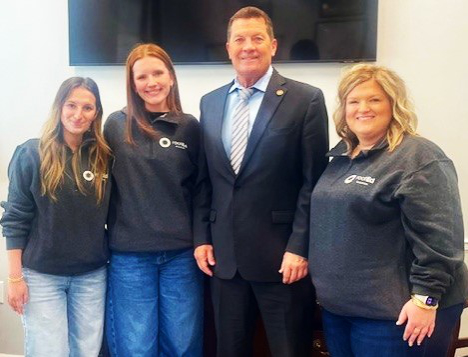
Senator Henderson talks with Kyrah Kreitler, Briana Pfaff and Erin Stoll, Advisor – rootED from Ste.
Genevieve HS.