
JEFFERSON CITY—The natural world is big and boisterous, full of singing insects, chattering birds, flashy butterflies, and other flamboyant creatures. Nature is also cryptic, minute, and quiet, full of micromoths flying with silent wings, fungi at work building soil, and millions of other unassuming life forms that we can all appreciate if we pause long enough to notice them.
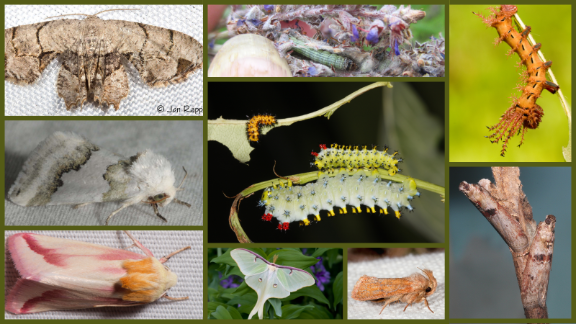
A few of the 3,000 moths occurring in Missouri include, in top row, from left: gray scoopwing (Callizzia amorata) by Jon Rapp; Sciota rubescentella caterpillar woven into a lead plant inflorescence by MJ Hatfield; caterpillar of a regal moth (Citheronia regalis) by Linda Williams; middle row from left: Hulst’s flower moth (Schinia hulstia) by Betsy Betros and cecropia moth caterpillars (Hyalophora cecropia) by Linda Williams; bottom row from left: clouded crimson moth (Schinia gaurae) by Betsy Betros; luna moth (Actias luna) by Linda Williams; eastern grass-tubeworm moth (Acrolophus plumifrontella) by MJ Hatfield, and two Sciota rubescentella adults. *Names in bold are prairie-obligate moths. The others may occur in prairies or other habitats.
The amazingly vast span of diversity in the natural world is expressed in many plant and animal groups—including moths. “Moths are dazzling in their diverse morphology—some are stunningly beautiful; others extremely cryptic,” said Missouri Prairie Foundation (MPF) Executive Director Carol Davit. “Many are important pollinators, as well as critical food for many songbirds and other wildlife. All are marvels of nature.”
National Moth Week (NMW) (this year, July 18 through 26) celebrates the beauty, life cycles, and habitats of moths, both large and micro. “Moth-ers” of all ages and abilities are encouraged to learn about, observe, and document moths in their backyards, parks, and neighborhoods. Missourians can also document moths—and many other plants and animals—occurring on Missouri Prairie Foundation (MPF) prairies through MPF’s iNaturalist Citizen Science Biodiversity Project.
NMW is recognized not just across the country, but worldwide. NMW offers everyone, everywhere a unique opportunity to become a citizen scientist and contribute scientific data about moths. Through partnerships with major online biological data depositories, NMW participants can help map moth distribution and provide important information on other life history aspects around the globe.
In Missouri, there are approximately 3,000 species of moths, with an estimated 190 species dependent on prairie for their survival. MPF’s prairie protection work helps sustain their populations.
Learn more about moths in and around grasslands in this Missouri Prairie Journal article by Phil Koenig. Learn about moths that depend on woody plants in this Grow Native! article in the Missouri Prairie Journal by Linda Williams and Mary Nemecek.
You can also establish habitat around your home with native plants to benefit moths and many other creatures. Find an abundance of resources at grownative.org. Additionally, you can play a role in moth conservation by reducing outdoor light—dark skies help moths and many other wildlife species, and are also important for human health. Learn more from Dark Sky Missouri.
Caption for composite photo: A few of the 3,000 moths occurring in Missouri include, in top row, from left: gray scoopwing (Callizzia amorata) by Jon Rapp; Sciota rubescentella caterpillar woven into a lead plant inflorescence by MJ Hatfield; caterpillar of a regal moth (Citheronia regalis) by Linda Williams; middle row from left: Hulst’s flower moth (Schinia hulstia) by Betsy Betros and cecropia moth caterpillars (Hyalophora cecropia) by Linda Williams; bottom row from left: clouded crimson moth (Schinia gaurae) by Betsy Betros; luna moth (Actias luna) by Linda Williams; eastern grass-tubeworm moth (Acrolophus plumifrontella) by MJ Hatfield, and two Sciota rubescentella adults. *Names in bold are prairie-obligate moths. The others may occur in prairies or other habitats.
The Missouri Prairie Foundation is a 60-year-old, nationally accredited land trust that protects and restores prairie and other native grasslands through acquisition, management, education, and prairie research. The organization owns 37 properties totaling more than 5,900 acres of prairie across the state open to the public to enjoy on foot, and, with partners, inspires the conservation of thousands more. The Missouri Prairie Foundation is also home to the 26-year-old Grow Native! native plant education and marketing program and administers the Missouri Invasive Plant Council.