SPRINGFIELD – The Illinois Department of Employment Security (IDES) announced today that the unemployment rate was 4.4 percent in November, unchanged from September, and down -0.5 percentage point from the same month, one year ago, based on data provided by the U.S. Bureau of Labor Statistics (BLS). The revised September unemployment rate was unchanged at 4.4 percent. There are no October unemployment rates for Illinois or the nation as labor force data for the month of October could not be collected from households during the federal government shutdown.
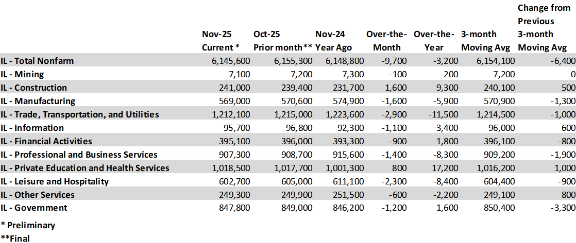
Total nonfarm payrolls were nearly unchanged over-the-month in November, down -9,700 (-0.2%) to 6,145,600. The September monthly change in payrolls was revised from the preliminary report, from -2,200 to -3,400. There was no October Illinois payroll jobs, unemployment rate news release due to the federal government shutdown. The November payroll jobs estimate and unemployment rate reflect activity for the week including the 12th.
The industry sectors with the largest monthly payroll jobs decreases included: Transportation and Utilities (-2,900), Leisure and Hospitality (-2,300), and Manufacturing (-1,600). The industry sectors with over-the-month jobs increases included: Construction (+1,600) and Private Education and Health Services (+800).
Compared to a year ago, total nonfarm payroll jobs decreased by -3,200 jobs. The industry groups with the largest jobs decreases included: Trade, Transportation and Utilities (-11,500), Leisure and Hospitality (-8,400), and Professional and Business Services (-8,300). The industry groups with the largest jobs increases included: Private Education and Health Services (+17,200), Construction (+9,300) and Information (+3,400). In November, total nonfarm payrolls were down -0.1 percent over-the-year in Illinois and up +0.6 percent in the nation.
“Though the Illinois unemployment rate remains stable, the payroll data underscores the severe uncertainty created by the federal government and shines a light on the increased challenges states will face if another shutdown occurs at the end of the month,” said Deputy Governor Andy Manar. “In the absence of reliable federal leadership, Illinois will remain committed to ensuring the state’s workforce ecosystem has the tools it needs to employ jobseekers and attract and retain business.”
“While the unemployment rate remains stable, DCEO is committed to advancing and increasing economic opportunity across the state,” said DCEO Director Kristin Richards. “The continued success of DCEO’s strategic initiatives and programs are critical to opening and strengthening opportunities for career-seekers and employers.”
The number of unemployed persons in November was 288,600, up +0.5% from September, and down -12.0% over the same month one year ago. The labor force decreased -0.3% from September and -1.6% over-the-year. The unemployment rate identifies those individuals who are out of work and seeking employment. An individual who exhausts or is ineligible for benefits is still reflected in the unemployment rate if they actively seek work.
IDES helps connect jobseekers to employers who are hiring in a number of ways, including hosting and co-hosting job fairs and hiring events with statewide workforce partners, and through maintaining Illinois JobLink (IJL), the state’s largest job search engine. IJL is a tool used by jobseekers to look for work, and by employers who can post open and available positions for hire and browse resumes. Recently, IJL showed 51,651 posted resumes with 65,157 jobs available. Additionally, in partnership with IDOL and DCEO, IDES published resources to assist federal employees and contractors impacted by recent terminations or deferred resignations.