
SIKESTON – Hunger is rising across Southeast Missouri, according to new Feeding America data showing nearly 69,210 people, about 1 in 5 Southeast Missourians, experienced food insecurity in 2024, a significant increase from just one year earlier when 63,790 individuals faced hunger. More than 20,680 children, or more than 1 in 4 children, are now estimated to face food insecurity across the region.
The annual Map the Meal Gap study estimates food insecurity across Southeast Missouri increased to 19.5% in 2024, well above Missouri’s statewide rate of 16.0%. The findings reflect growing pressure on families already struggling with higher costs for food, housing, transportation and other essentials.
“These numbers confirm what we’re seeing every day: More children, seniors and working families are struggling to put food on the table,” said Joey Keys, President & CEO of Southeast Missouri Food Bank. “Rising costs continue to put healthy food out of reach for many families, and more neighbors who have never needed help before are now turning to food assistance simply to make ends meet.”
Nearly 45.3% of people experiencing food insecurity earn too much to qualify for SNAP benefits, leaving many working households without access to nutrition assistance despite struggling to afford groceries. The findings also reinforce what Southeast Missouri Food Bank sees every day across its service area.
Nationally, more than 8 in 10 counties with the highest estimated food insecurity rates are rural. That reality is reflected close to home, where Wayne, Carter and Pemiscot counties rank among the 100 counties with the highest food insecurity rates in the nation. In Missouri, the six counties with the highest food insecurity rates are all within Southeast Missouri Food Bank’s 16-county service area, and seven of the state’s eight highest-ranking counties are served by the Food Bank.
For Tina, a lifelong resident of Wardell in Pemiscot County, those statistics reflect everyday life. For years, her community had no grocery store, requiring residents to travel 20 to 30 minutes just to buy food. With only one family vehicle, getting groceries wasn’t always easy.
“We’re a small community, but we still need to eat,” Tina said. For many families in rural communities, accessing healthy food isn’t as simple as driving to the nearest grocery store. Limited food retailers, transportation barriers and rising costs make putting nutritious meals on the table even more difficult.
“No one organization can solve hunger alone,” Keys said. “But together, with volunteers, donors, farmers, businesses, schools and community partners, we can ensure every neighbor has reliable access to nutritious food.”
The study estimates that people experiencing food insecurity in Southeast Missouri would need an additional $20.41 per week per person to afford enough food, creating an estimated annual food budget shortfall of nearly $42.9 million across the region.
Key findings from Map the Meal Gap include:
- Hunger remains higher in Southeast Missouri than statewide. Missouri’s overall food insecurity rate is 16%. Across Southeast Missouri Food Bank’s 16-county service area, the rate is 19.5%, ranging from 26% in Wayne County to 14.1% in Ste. Genevieve County.
- Many working families don’t qualify for assistance. 45.3% of people experiencing food insecurity in Southeast Missouri have incomes above the SNAP eligibility threshold, leaving many households without access to federal nutrition assistance despite struggling to afford groceries.
- Rural communities continue to face the greatest need. Nationally, more than 8 in 10 counties with the highest food insecurity rates are rural. That trend is reflected in Southeast Missouri, where Wayne, Carter and Pemiscot counties rank among the 100 counties with the highest food insecurity rates in the nation.
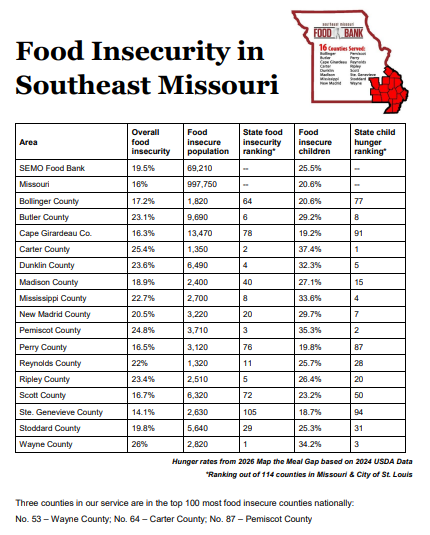
The six counties with the highest food insecurity rates in Missouri are all within Southeast Missouri Food Bank’s service area, and seven of the state’s eight highest-ranking counties are served by the Food Bank.
- Families continue to face a significant food budget gap. People experiencing food insecurity in Southeast Missouri would need an additional $20.41 per person, per week to consistently afford enough food, creating an estimated annual food budget shortfall of nearly $43 million across the region.
Although the U.S. Department of Agriculture has discontinued collecting national food security survey data, Feeding America will continue estimating local food insecurity using publicly available data and alternative research sources.
The Map the Meal Gap study provides county-level estimates of food insecurity, meal costs and food budget shortfalls for every county in the United States. Map the Meal Gap is supported by Conagra Brands Foundation, Enterprise Mobility Foundation and NielsenIQ/NIQ.
To explore county-level food insecurity data, visit www.FeedingAmerica.org/MaptheMealGap
To learn more about Southeast Missouri Food Bank or how to help neighbors facing hunger, visit www.semofoodbank.org.
About Southeast Missouri Food Bank
The mission of Southeast Missouri Food Bank is to end hunger and leverage the power of food to build healthy communities. The food bank provides food to 140 charitable and disaster relief programs in Southeast Missouri. These member agencies include food pantries, soup kitchens, domestic violence and homeless shelters. Southeast Missouri Food Bank also holds regular mobile food distributions and provides monthly boxes of food to 5,600 senior citizens and weekend backpacks of food during the school year to 1,100 students in area school districts. The food bank’s 16-county coverage area includes Bollinger, Butler, Cape Girardeau, Carter, Dunklin, Madison, Mississippi, New Madrid, Pemiscot, Perry, Reynolds, Ripley, Scott, Ste. Genevieve, Stoddard and Wayne counties.
Those interested in helping can do so by making a tax-deductible contribution, donating food, or scheduling a time to volunteer. Visit semofoodbank.org for more information. About Feeding America Rooted in the voices of neighbors facing hunger, Feeding America unites the country ensuring everyone has access to food and a thriving future.
We support tens of millions of people as part of a nationwide network of 250+ food banks, 20+ statewide food bank associations, 10+ regional co-ops and 60,000+ agency partners, food pantries and meal programs. Powered by leaders and volunteers embedded in local communities, we are one of the nation’s most effective food distribution systems driving immediate impact today—and a catalyst for long-term change through advocating for legislation that improves food security and work to address its factors. We partner with people experiencing food insecurity, policymakers, organizations and supporters united with the unwavering commitment to provide nourishing food and work to end hunger at its roots so everyone can live fuller, healthier lives. Visit FeedingAmerica.org to learn more.