
These invasive woody plants are easily recognizable in fall, making this season ideal for controlling them to reduce their spread.
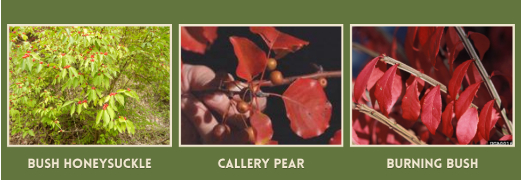
Jefferson City, MO (November 16, 2026) — The Missouri Invasive Plant Council (MoIP) urges Missourians to treat three invasive woody plants this fall. Originally planted for ornamental purposes, non-native bush honeysuckle, Callery (Bradford) pear, and burning bush have spread into intact habitat, degrading habitat for wildlife, impacting timber harvests, and negatively impacting livestock pastures. At this time of year, the foliage of these three invasive plants helps make them readily identifiable in wooded habitats.
Note: When controlling invasive plants, use personal protective equipment (PPE) and always follow herbicide label instructions.
Bush honeysuckle (Lonicera maackii and other non-native Lonicera shrub species). These invasive shrubs, native to eastern and temperate Asia, can dominate wooded understories, shading out native wildflowers, shrubs, and oak, hickory, and other tree seedlings. In mid- to late fall, the leaves of bush honeysuckle remain on the shrubs after leaves of native shrubs have fallen.
Bush honeysuckle leaves are yellow-green in fall, and the shrubs often have many bright red berries, which helps in their identification. When fully mature, bush honeysuckle shrubs can reach a height of 15 to 20 feet tall. Leaves are opposite, 1 to 3 inches long, and narrowly oval with a pointed tip. The bark is grayish brown and tight with grooves running vertically.
Once identified, recommended control varies depending on shrub size and density, as well as landscape type. Small plants can simply be pulled by hand, as they are shallow-rooted.
For larger plants, the method that may be especially desirable for yards or parks is to cut stems with loppers or a saw and then daub the cut stems with a 10% to 20% solution of glyphosate.
For plants with a diameter smaller than 6 inches, basal bark treatments are very effective with 20% to 30% triclopyr in basal oil.
For dense colonies (for example, in woodlands), the easiest treatment is often foliar spraying with a 1% to 4% solution of glyphosate. For foliar spraying, use thorough, even coverage on the leaves, stopping before runoff occurs. If the shrub is above shoulder height, do not spray overhead as a safety precaution; instead, use the cut stump or basal bark methods. Because frost causes most native species to go dormant, waiting until after a frost to foliar treat bush honeysuckle minimizes collateral damage to native plants.
Callery pear (Pyrus calleryeana). Callery pear trees (Pyrus calleryana), native to eastern Asia, include 26 cultivars (e.g., Cleveland, Bradford, and Chanticleer) that are spreading rapidly across Missouri, degrading original habitats and invading pastures and roadsides. The trees are most noticeable in spring when the trees are in bloom with abundant white flowers, and also in fall with brilliant reddish purple or orange-red foliage.
Callery pear trees can grow to 30 to 50 feet. The limbs generally grow vertically, forming a pyramid or egg shape. Branches are sometimes thorny; leaves are shiny, dark green, and leathery, with small-toothed margins. Leaves turn reddish purple or orangish red in the fall. Abundant, unpleasant-smelling white flowers bloom in spring before leaf-out. Fruits in fall are small, round, hard, and brown.
In fall, Callery pear trees can be treated in three ways:
Basal bark treatment: For tree trunks/main stems less than 6 inches in diameter, make a 20% solution of triclopyr combined with basal oil and apply with a squirt bottle, hand sprayer, or backpack sprayer. Spray the basal parts of brush and tree trunks to a height of 12 to 15 inches from the ground, thoroughly wetting the indicated area, but stopping before runoff occurs.
Hack & squirt: For tree trunks/main stems greater than 6 inches in diameter, use a hatchet to make downward angled cuts deep enough to get into the living cambium just within the bark layer and make one hack per 3 to 4 inches of tree diameter in one line around the stem. Squirt herbicide into the cut: a mix of at least 50% triclopyr (Garlon® 3A – amine formulation – is recommended) in water. Make enough hacks to go around the diameter of the tree. Stop squirting before runoff occurs.
Cut stump: For larger trees or trees with rough bark, use the cut stump treatment method. Using a paintbrush or foam dauber, “paint” the cut with a 10% to 20% solution of glyphosate immediately after cutting.
Burning bush (Euonymus alatus). This invasive shrub, native to northeastern and eastern Asia, and widely planted as a landscaping ornamental in North America, is spreading rapidly into forests and woodlands. In fall, it is readily identifiable by its brilliant red leaves. This deciduous shrub can grow to 20 feet. Two to four corky ridges often form along the length of young stems, though they may not appear in shaded areas or closed canopies. The opposite, dark green leaves are < 2 inches long, smooth, rounded, and taper at the tips. The leaves turn bright crimson to purple in the fall. The flowers are inconspicuous, greenish yellow, and have four petals. Flowers develop from late April to June and lie flat against the leaves. The fruits, which appear from September to October, are reddish capsules that split to reveal orange fleshy seeds.
To treat in fall, cut stems/trunks with loppers or a saw and then daub or spray the cut stems immediately with a 10% to 20% solution of glyphosate mixed with water. Basal bark treatments are also effective with a 20% to 30% solution of triclopyr ester (trade name: Garlon 4) and basal oil.
MoIP offers additional information and resources regarding ID and control of these and many other invasive plants.
About MoIP
The Missouri Invasive Plant Council (MoIP) advocates for making early detection and control of known and potential invasive plants a statewide priority. In 2015, the Missouri Prairie Foundation’s Grow Native! program spearheaded this multi-agency, multi-industry networking and advocacy group to bolster statewide efforts to identify and control the invasive plants that severely impact several sectors of the Missouri economy and native biodiversity. MoIP reviews, discusses, and recommends educational and regulatory action related to managing known and potential non-native invasive plants. Representatives from the fields of conservation, agriculture, botanical science, ecological services, plant production, horticulture, landscape services and design, and arboriculture serve on MoIP.