
COLUMBIA, Mo. – Instead of signaling an end to the garden’s visual appeal, hot summer weather simply sets the stage for heat-loving flowers to take over and truly shine.
The right plant in the right place makes gardens burst with summer color, says University of Missouri Extension horticulture specialist David Trinklein. The wrong plant is a disappointment as well as a waste of money, time and effort.
Trinklein advises gardeners to choose plants carefully based on the American Horticultural Society’s heat zone map (https://bit.ly/4vOssXx), the high-temperature equivalent to the USDA plant hardiness zone map.
“Large retail outlets may sell plants not suited to their area’s extreme temperatures,” Trinklein said. “Just because it looks pretty in the store doesn’t guarantee that it will be attractive for long periods of time in a garden.” For example, Osteospermum (cape daisy), is a cheerful daisy-like flower that is billed for full sun. While attractive in spring, in Missouri it disappoints most gardeners when weather turns hot.
A flower’s origin can give clues to how well it will adapt to Missouri, he said. Some species came to the United States from northern Europe, where it is much cooler. As Europeans traveled from their original port of entry, flowers traveled with them. Some flowers tolerated the heat of Missouri and other more southern states. Others did not. Geraniums are a good example: They are often sold as full-sun plants, but in Missouri they are at their best with morning sun and afternoon shade.
Fortunately, several ornamental plants do very well in the heat and humidity typical of a Missouri summer, said Trinklein.
Vinca is among the most heat-tolerant flowering plants commonly available. It thrives in hot weather and is available in a wide array of colors in both upright and trailing growth habits.
Zinnia, native to Mexico, is heat-loving, easy to grow and available in a variety of colors and plant heights.
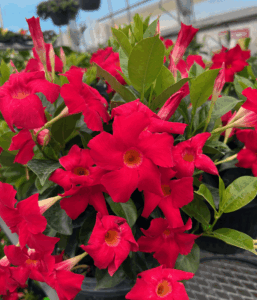
Mandevilla. MU Extension horticulture specialist David Trinklein says plants like the Mandevilla love Missouri heat. Photo courtesy of David Trinklein.
Mandevilla, native to Brazil, is a heat-tolerant vine with large, showy flowers. It loves Missouri summers, as does bougainvillea, another native of Brazil that produces bright clusters of showy bracts on graceful, arching branches. Lantana, a native of South America and Africa, is both heat- and drought-tolerant and excels as a landscape or container plant.
Angelonia, a compact plant with salvia-like spikes, is gaining popularity because of its heat tolerance. Also known as summer snapdragon, it adds bright color to hot, sunny spots and comes in a variety of colors.
Petunia, once considered to thrive only in cool weather, has been improved to exhibit remarkable resilience in intense summer heat when given proper care. Many modern hybrid varieties, such as the Wave and Supertunia series, are specifically bred to withstand sustained temperatures well above 90 F. Calibrachoa, which resembles a miniature petunia, tolerates heat well but in Missouri performs best in containers filled with a soilless growing medium.
While many flowering annuals fade in the heat of July and August, marigolds persist, providing brilliant yellows, oranges and rusty reds through the hottest months and into the early fall. The same can be said for canna. Beyond the flowers, canna leaves offer bold, tropical colors, including striking bronze, burgundy and variegated stripes. New varieties of dwarf cannas are available with sturdy, stocky stems that handle fierce summer heat and winds with ease.
Scaevola, also known as fan flower, is beloved for its remarkable endurance through extreme summer temperatures. Native to Australia, it produces prolific, half-fan-shaped blooms in shades of vibrant blue, pink and white from late spring through the first hard frost.
Trinklein encourages gardeners to try new varieties. However, since most large retail outlets primarily carry tried and true best sellers, local retail greenhouses and garden centers might be the best place to find new varieties that are worth a look, he says.
For more information, refer to the MU Extension publication “Flowering Annuals: Characteristics and Culture,” available for free online at https://extension.missouri.edu/publications/g6629.