Celebrating our American ideals, 250 years later
Reflections of Missouri Chief Justice W. Brent Powell
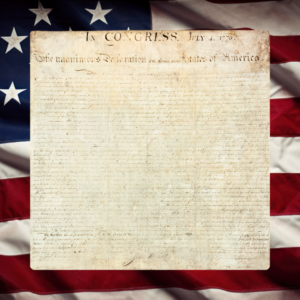
Growing up, the Fourth of July meant lots of family, fun, food … and of course, fireworks! But I’ve since come to appreciate what the holiday is meant to celebrate – the Declaration of Independence. And so this year – the 250th anniversary of its signing – I hope all of you enjoy the Fourth of July festivities but also stop and reflect on what the holiday truly represents.
The Fourth of July commemorates our American story. It is a story of hopes, dreams, hard work, courage, and sacrifice. This remarkable story began 250 years ago, when representatives of American colonies risked their lives and fortunes to declare independence from a monarch ruling an ocean away.
But that moment was about more than just declaring independence. It was a monumental act of cooperation in the face of divisive factions. Each colony had its own culture and beliefs, and colonists identified more with their individual colony than as Americans. But shared grievances and complaints against the king brought these diverse groups together. Delegates from the 13 colonies set aside their differences to chart a united path forward, emphasizing life, liberty, and the pursuit of happiness – principles forming the bedrock of our constitution and government.
During the last 250 years, these bedrock principles and unity as Americans have been tested repeatedly … through economic crises, political unrest, and civil war. Even today, it can be easy to let ourselves as Missourians be divided by our differences. Yes, we live in different parts of the state and have different cultures and beliefs. But as we celebrate this Fourth of July, let us come together with patriotic spirit – united as Americans – focused on promoting the virtues of life, liberty, and happiness as our founders so gallantly declared 250 years ago.
We must unite in dedication to these virtues because ours is still a fairly new nation. We have achieved much over the last 250 years, but more remains to be done. The ideals of freedom and equality are mere promises, not guarantees. So it is imperative each generation reflects on the sacrifices of the past and recommits to making these ideals a reality for the future. As Benjamin Franklin famously remarked, we have a republic, if we can keep it.
The architects of our nation created a government designed for people to propose competing ideas drawn from their knowledge, experience, and wisdom and then, through reasoned debate, reach collaborative decisions. These decisions form our body of law. The founders recognized our inherent right to disagree, but it is essential we – as the people of one nation – accept and agree to be bound by this body of law. This enduring commitment to the rule of law has made our nation great for the last 250 years and will continue to make it great for centuries to come.
Our constitution created courts to resolve our legal disputes and enforce the rule of law when disagreements do arise. And, because our founders built a government from the ground up, our courts are run by people in your community. So when you think of “the judiciary,” think of the hard-working court staff from your local courthouses. Last year alone, they collectively resolved more than 1.4 million cases. Most never generated a headline, but every single one of those cases profoundly affected the people involved. Maybe some of those cases impacted your friends, neighbors, relatives … or even you.
When resolving these cases, judges are guided by the rule of law and our oath to support the constitution of the United States and the constitution of this state. Fulfilling this oath can be challenging, leading to decisions we may personally dislike or that may be unpopular. But as public servants, we all willingly accept this responsibility. No matter how difficult or distasteful the circumstances, we must always adhere to the rule of law and abide by our oaths, doing what the constitution and the law require.
Our challenges, however, pale in comparison with those our founders faced 250 years ago. They tackled that pivotal moment with an open mind, a desire to find a better way, and the courage to risk their fortunes – and their lives – to chart a new course. Working together, they declared all colonists both independent and united despite their differences, laying the foundation for a new nation grounded in self-evident truths.
Abraham Lincoln famously echoed those ideals nearly a century later while traveling to Washington to assume the presidency. Addressing a crowd at Philadelphia’s Independence Hall – where the Declaration of Independence was signed – Lincoln eloquently stated:
I am filled with deep emotion at finding myself standing here, in this place, where were collected together the wisdom, the patriotism, the devotion to principle, from which sprang the institutions under which we live. … I have often inquired of myself, what great principle or idea it was that kept this Confederacy so long together. It was not the mere matter of the separation of the Colonies from the motherland; but that sentiment in the Declaration of Independence which gave liberty, not alone to the people of this country, but, I hope, to the world, for all future time.
I believe the wisdom, patriotism, and devotion to principle exhibited in 1776 endure today. I firmly believe the truths our Declaration of Independence boldly proclaimed remain the heart of our nation and this great state. But it is incumbent on all of us to model the collaborative spirit of 1776, using our collective wisdom and patriotism to ensure those self-evident truths are reflected in the lives of all Missourians.
I hope you will embrace the ideals of life, liberty, and pursuit of happiness as you enjoy a safe and festive Fourth of July.
Photo of Chief Justice Brent Powell and his wife in front of the Liberty Bell during a December 2019 visit to Philadelphia. In the background is Independence Hall, where the Declaration of Liberty was signed. (courtesy Chief Justice W. Brent Powell):