
COLUMBIA, Mo. – University of Missouri Extension’s Plant Diagnostic Clinic, in partnership with the Missouri Department of Conservation (MDC), continues to offer free testing for all common oak tree diseases.
“We had a great season in 2025, as we received over 100 oak samples and diagnosed diseases including tubakia leaf spot, bacterial leaf scorch, oak wilt, anthracnose, leaf galls and so on,” says Peng Tian, director of the Plant Diagnostic Clinic on the MU campus.
“This allowed us to monitor the prevalence of the common diseases currently affecting oak trees in Missouri and scout for new or invasive diseases to better assist MDC with controlling forest pest problems,” Tian says. “With this service, we hope to continue collecting information on the location and host species of oak diseases across the state and monitor the tree health of the state.”
Oaks are the most abundant trees in yard and forest settings across Missouri. Two common oak diseases are bacterial leaf scorch and oak wilt. Oak wilt weakens white oaks and kills red oak trees within months of infection. Bacterial leaf scorch is a chronic disease that worsens over several years. Both diseases spread to nearby oaks.
In red oak trees, oak wilt symptoms first appear in late spring or early summer. Leaves discolor, wilt and fall, first at the top of the tree and later at the tips of lateral branches. Leaves turn a dull, bronzed brown at the tips and along the outer margins. Similar symptoms appear in white oak trees in mid-to-late summer. Trees infected for two or more years commonly develop isolated dead branches in the crown.
Bacterial leaf scorch infects the xylem of susceptible trees and prevents transport of water and nutrients. There is no cure for bacterial leaf scorch on oak, and trees die in 5-8 years. Symptoms may look like drought stress and can only be diagnosed by laboratory analysis.
If you suspect either disease in your trees, Tian recommends sending samples to the clinic for testing and confirmation.
First, send 3-5 photos of the tree to the clinic through digital sample submission at https://muext.us/PlantClinicDSS. The fee noted on the website will be waived for tests for common oak diseases. Tian suggests taking both close-up photos and photos from a distance.
“MU Plant Diagnostic Clinic staff will contact you regarding the physical sample submission guidelines, depending on the tree health problems observed in the photos,” he says.
For bacterial leaf scorch, select leaves that are still green but show leaf scorch symptoms. Collect 20-30 leaves with the petiole (leaf stem) attached, and pack them in a sealed plastic storage bag with a damp paper towel. Keep the leaves cool. For oak wilt testing, collect 4-6 branch sections that are about 8-12 inches long, roughly 0.5-1.5-inch in diameter and alive but showing symptoms of leaf wilt.
“Keep samples cool, but do not freeze them,” says Tian. “Samples that get hot during transit to the lab may not test positive for the fungus.”
For more information on sample submission, go to the MU Plant Diagnostic Clinic website at https://muext.us/PlantClinic.
The clinic is at 1100 University Ave., 28 Mumford Hall, on the MU campus in Columbia and is open 9 a.m.-4 p.m. Monday-Friday.
Video
https://youtu.be/9g312_U1iiI
MU Plant Diagnostic Clinic sample submission instructions.
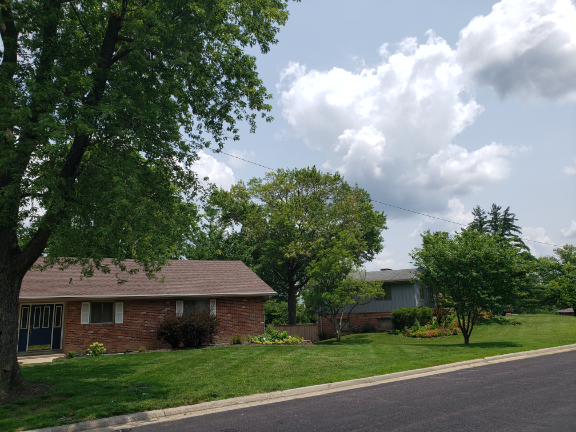
Photo by Clinton Meinhardt, MU Life Sciences Center.
Signs of disease can be seen in this oak tree immediately to the right of the brick house. MU Extension’s Plant Diagnostic Clinic, in partnership with the Missouri Department of Conservation, is offering free testing for all common oak tree diseases this year.
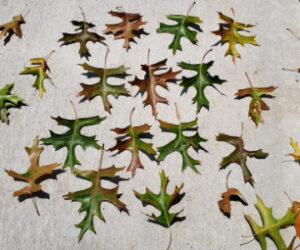
Photo by Clinton Meinhardt, MU Life Sciences Center.
With oak wilt, leaves discolor, wilt and fall at the top of the tree first and later at the tips of lateral branches. Leaves turn a dull, bronzed brown at the tips and along the outer margins. MU Extension and MDC have partnered again this year to offer free testing for all common oak tree diseases.
MU Extension is the link between the University of Missouri’s proven research, knowledge and resources and more than 6 million Missourians. With state and local partners, we deliver real-world solutions to address our state’s grand challenges around agriculture, economic opportunity, educational access and health and well-being. Faculty and staff in 114 counties and the city of St. Louis work to empower people, strengthen communities and develop leaders. True to our land-grant mission, we serve Missouri and deliver Mizzou as we improve lives and opportunities.
MU Extension news: extension.missouri.edu/news