
BOONVILLE, Mo. – White flowers in Missouri pastures, fencerows and along roadsides in June look benign. However, they are anything but, says Todd Lorenz, University of Missouri Extension field specialist in agronomy.
Poison hemlock is a prolific, highly toxic biennial weed that poses serious threats to people and livestock. Each plant produces up to 38,000 seeds, guaranteeing its spread, especially in no-till crop fields.
Every inch of the plant is poisonous, whether green or dried, says Lorenz.
Where and when it grows
Poison hemlock came to the United States as a garden plant. It now grows along roadsides, on field edges, along creek beds and ditches.
It is one of the earliest weeds to green up in spring and can grow as tall as 6 feet with flowers that measure 7-15 inches across.
In its first year, it grows as a low-lying basal rosette. In the second year, it produces erect stems topped with large, umbrella-shaped clusters of white flowers.
Early control needed
“The key to managing poison hemlock is early identification and control,” Lorenz says. “Once plants mature, they become much harder to control.”
Nonchemical control options are hand removal, mowing and tillage. Lorenz urges extreme care to avoid poisoning through touching the plant or breathing its residue when removing.
In crop and pasture settings, growth-regulator herbicides and products containing 2,4-D, dicamba, metsulfuron, triclopyr, or 2,4-D can be effective when applied at the rosette stage, says MU Extension weed scientist Kevin Bradley. Unfortunately, plants that are flowering and more noticeable at this time of year are well past that stage, says Bradley. Treat much earlier, as mature plants do not respond well to broadcast sprays. Plants that are blooming or past the bloom stage require spot treatments at much higher concentrations.
Bradley notes that research shows that tank mixes of dicamba plus glyphosate may provide more consistent control than glyphosate combined with 2,4-D.
Even small amounts harm livestock
Poison hemlock is especially dangerous to livestock; even small amounts can cause death. Its alkaloids can affect the nervous system and lead to symptoms such as trembling, dilated pupils, abnormal heart rate and respiratory failure.
Poison hemlock’s young leaves are not palatable, and livestock will avoid it if another feed source is available. Dried leaves can still end up in hay and be deadly.
If you suspect poisoning, immediately remove animals from infested pastures and contact a veterinarian. Pregnant livestock exposed to poison hemlock during the first trimester may give birth to offspring with limb deformities, a condition often referred to as crooked calf syndrome.
Take care when handling
When handling poison hemlock, wear protective clothing, including gloves, long sleeves, long pants and eye protection. Contact with plant sap can cause skin irritation, blisters and welts.
Poison hemlock is often mistaken for Queen Anne’s lace, also known as wild carrot. Its roots can be confused with wild carrots or parsnips. Both plants have hollow stems and white, lacy flowers, but poison hemlock has smooth, hairless stems with distinctive purple blotches. Queen Anne’s lace also typically grows no taller than 2 feet and is not toxic.
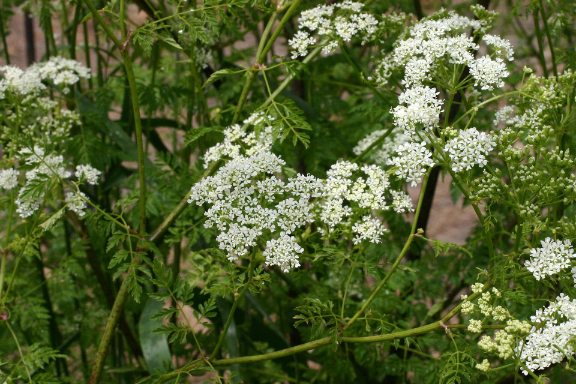
Poison hemlock. Eric Coombs, Oregon Department of Agriculture, Bugwood.org. Shared under a Creative Commons license (CC BY 3.0).
How to identify
To identify poison hemlock, check the following:
- Height: Grows 6 feet tall or more when mature.
- Stems: Smooth, hollow and hairless, with distinctive purple blotches or streaks.
- Leaves: Finely divided, fern-like leaves with a strong, unpleasant odor when crushed.
- Flowers: Small white flowers arranged in umbrella-shaped clusters.
- Growth habit: Forms a low basal rosette the first year; bolts and flowers in the second year.
If you are unsure of any plant’s identity, avoid handling it, says Bradley.
MU Integrated Pest Management offers several tools to identify weeds. Go to weedid.missouri.edu, the MU Extension guide Plants Poisonous to Livestock or the article Poison Hemlock.