
Slow down when you see a turtle in the road and try to safely steer around it.
JEFFERSON CITY, Mo. – The Missouri Department of Conservation (MDC) encourages motorists to give turtles crossing roads a “brake.”
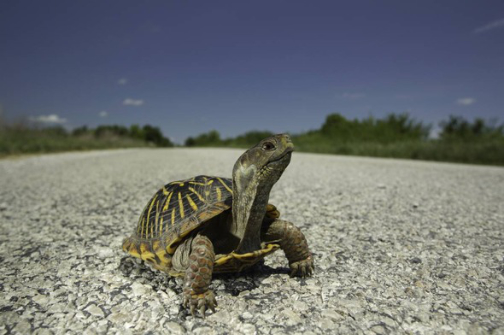
Box turtles (shown is an ornate box turtle) are a species often seen crossing roads in Missouri during spring. MDC encourages motorists to slow down when they see a turtle in the road and check to be sure they can safely steer around it.
Spring rains and warmer weather encourage turtles to emerge from their burrows and begin to search for food and mates. This leads some turtles across roadways – and puts them at risk of being struck, injured, and often killed by motor vehicles. Three-toed box turtles, ornate box turtles, and common snapping turtles are species often seen crossing roads in Missouri.
Turtles spend most of their lives in a small area of habitat but sometimes wander as much as six miles. Young males make up most of the travelers across roads as they search for territories of their own and for females. Females are also crossing roads in search of nesting sites.
Comfort is also a factor. Like other reptiles, turtles are cold-blooded so basking on warm asphalt feels good on cool spring days.
MDC encourages motorists to slow down when they see a turtle in the road and check to be sure they can safely steer around it. If helping a turtle cross a road, keep human safety as the number-one concern. Check for traffic and move the turtle across the road in the direction it is traveling.
For more information on turtles crossing roads, watch this short MDC video at youtube.com/watch?v=4KaTQ66uBhY.
Working with MoDOT on Wildlife-Vehicle Collisions
MDC is working with the Missouri Department of Transportation (MoDOT) on broader wildlife safety efforts with the completion of Missouri’s Wildlife‑Vehicle Collision Study, conducted by HDR Engineering, Inc. and the Wildlife Connectivity Institute.
The study identifies where wildlife-vehicle conflicts occur most often and recommends strategies to improve safety while keeping animals connected to their habitats. Learn more at modot.org/wildlife-vehicle-collision-study
Alongside the study, MoDOT has launched the ROaDS (Roadkill Observation and Data System) app, a citizen‑science survey that allows the public to report roadkill or animals near roadways.
Reptiles and amphibians frequently cross roads as they move to breeding or hibernation sites and are often hit by vehicles without being reported. Public observations reported via ROaDS will help fill important data gaps and support conservation efforts statewide. Learn more at modot.org/roadkill-observation-and-data-system-roads
Leave Wildlife Wild
MDC also advises people to leave wild turtles wild. Taking a wild turtle and keeping it as a pet usually ends in a slow death for the captive turtle.
While most Missouri turtles live 15 to 30 years, box turtles can live 50 to 80 years, occasionally more than 100 years. They spend their quiet lives eating plants, earthworms and insects. Their shell provides a bony shield to protect them from most natural enemies. For more information on Missouri turtles, visit MDC’s online Field Guide at mdc.mo.gov/field-guide/full-text-search?query=turtles.
|