
JOPLIN, Mo. – Most everyone has a hobby or two. Some specialize in painting miniature figurines while others tie flies. Some are like Missouri Department of Conservation (MDC) staffer, Meagan Duffee-Yates, who dedicates some—or a lot—of her free time to falconry.
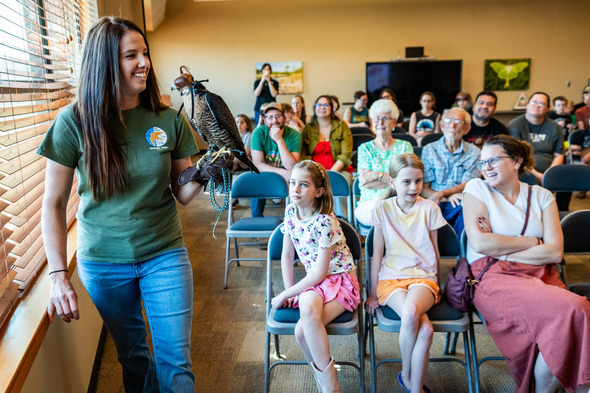
Duffee-Yates, who is an MDC Private Land Conservationist along with being an avid spring turkey hunter, discussed her love of falconry, how she became interested in the sport, and more during a March 21 program at Shoal Creek Conservation Education Center in Joplin.
Falconry is the ancient sport of hunting wild game in their natural habitat with trained raptors. Raptors are apex predators that are indicators of a healthy ecosystem, and they are protected by state and federal law. There are more than 500 species of raptors in the world, with 52 raptor species in North America.
At least 34 species of raptors have been observed in Missouri and 23 have been observed nesting in the state.
Duffee-Yates is a member of the North American Falconers Association, which was founded in 1961 to encourage the proper practice of the sport of falconry and the wise use and conservation of birds of prey.
Becoming a falconer is a major time commitment, and there are three classes: apprentice, general, and master.
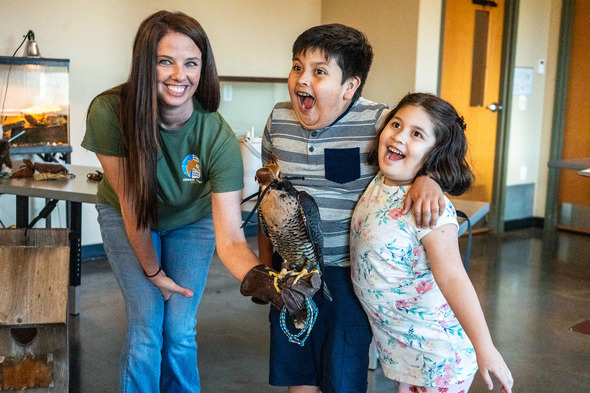
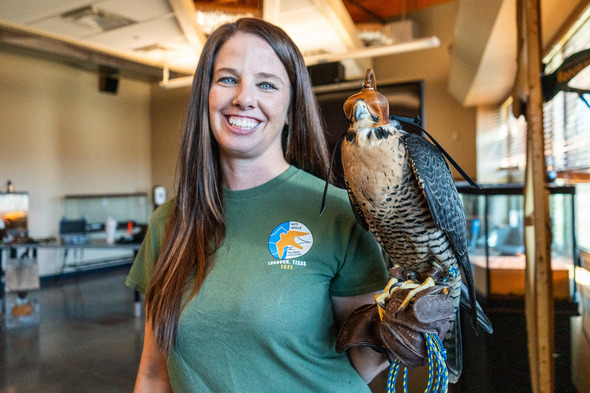
DC’s Meagan Duffee-Yates walks Ryuk, a female peregrine falcon, around a classroom (top photo), pauses for a photo with two children (above photo), and holds Ryuk (pictured below and final photo) at a program discussing the centuries-old practice of falconry March 21 at Shoal Creek Conservation Education Center in Joplin.
“Our state and federal permits allow us to capture a juvenile bird of prey from the wild, as more than 70% of these juveniles will be dead before their first birthday,” Duffee-Yates explained. “Becoming a falconry bird allows them to have safe housing, food and proper vet treatment. The three classes allow us to use different birds of prey based on experience.”
An apprentice must study under the guidance of a general or master class falconer. They are apprentices for their first two years, during which they will learn the aspects of being a falconer. Once they have served as an apprentice for two years, they qualify as a general and no longer need a sponsor. They are a general for five years before they become a master falconer, which allows falconers to pursue and hunt with a golden eagle after several federal requirements. Most falconers in Missouri do not hunt with a golden eagle due to lack of space and prey that these massive birds hunt.
“Necessary training is all about gaining the trust of the bird,” Duffee-Yates explained. “We start off with a freshly trapped bird and want to gain their trust via food association. They will be scared of us at first but learn very quickly that humans mean food. Once we have established the food association part, we work on getting them to first hop to the fist and then fly to the fist, all while making the distance between us further and further, until finally they are ready for free flight. During which time nothing keeps the bird tethered to us. After their first free flight we then go out and start hunting.”
Apprentices are required to work with an experienced falconer for two years and are limited to two birds. After two years, apprentices move to the general class, are allowed two birds and can replace them once in a 12-month period. After five years at the general class, falconers move to the master class, which allows them to have three birds and frequently replace them.
Duffee-Yates stressed the importance of remembering that these raptors are not pets.
“At most, we are coworkers,” Duffee-Yates said. “My birds do not love me; they see me as a partner that offers them food and more opportunities to hunt prey.”
While falconry dates back thousands of years, much of the essential equipment has remained the same. Falconers still use gauntlets, hoods, bells, and more when working with their raptors. Duffee-Yates explained that technology, like Global Positioning System (GPS), has also helped in tracking the speed and location of birds.
Before wrapping up her program, Duffee-Yates introduced the crowd to a female peregrine falcon she has been working with, named Ryuk. The peregrine falcon was trapped on South Patre Island as a juvenile five years ago. Now, Duffee-Yates enlists Ryuk to hunt ducks.
“Each bird that I have hunted with all have different personalities, no two are the same, even if they are of the same species,” Duffee-Yates said. “Each new bird offers to me a new learning experience and a new view point into the predator prey relationship that most people don’t get to witness.”
Learn more about the North American Falconers Association at www.n-a-f-a.com/.
For information about future events at Shoal Creek Conservation Education Center, call 417-629-3434. The education center is located at 201 West Riviera Drive in Joplin.
Staff at MDC facilities across the state are holding virtual and in-person programs throughout the year. The programs may be found at mdc.mo.gov/events.